
Changing Habits: 10 Books That Finally Make It Work
Why are habits so important? Because almost everything we do and think is based on our habits. They make up 45% of our daily actions. [1] [1] 45% of our behaviour is repeated daily: Wood, Wendy/Qinn, Jeffrey M./ Kashy, Deborah A. (2002): Habits in Everyday Life: Thought, Emotion and Action, in: Journal of Personality and Social Psychology, Issue 83 (6)
But that's not all. Anyone who believes that our thoughts are always the result of careful consideration is wrong. After all, 70% of our daily thoughts are identical to those from the day before. [2] [2] 70% of our thoughts are repeated daily: Wood, Wendy/Qinn, Jeffrey M./ Kashy, Deborah A. (2002): Habits in Everyday Life: Thought, Emotion and Action, in: Journal of Personality and Social Psychology, Issue 83 (6)
Overall, habits guide more than 90% of our daily decisions. [3] [3] Only 5% of our decisions are conscious: Zaltmann, Gerald (2003): How Customers Think: Essential Insights into the Mind of the Market
The problem is: Although we actually know exactly which habits we need to change to live a healthier, more successful, and more relaxed life, we repeatedly do the exact opposite. "Knowing" and "Doing" unfortunately don't live on the same street. When it comes to deeply ingrained habits, they don't even have the same postcode. One of the greatest health campaigns of all time illustrates this phenomenon:
The "5-a-Day Campaign"
In the late 1980s, studies in California were able to clearly demonstrate for the first time that eating fruits and vegetables could prevent cancer – the diseases Americans fear most. [4] [4] Americans fear nothing more than cancer: Author/Source (Year): Title of the source including link
In addition, it was shown that about five servings a day produced the optimal preventive effect. So the American government launched the so-called "5-a-Day Campaign" ("5 A Day"). Memorable advertising posters were printed, free recipe books were distributed in supermarkets, cute cartoons were placed in schoolbooks, and so on. The "5-a-Day Campaign" was a complete success: Before it began, only 8% of all Americans knew that five servings of fruit and vegetables a day were healthy. Ten years after the campaign launched, about 40% knew – a result any political advisor would be proud of. [5] [5] The 5-a-Day Campaign changed what Americans knew: Author/Source (Year): Title of the source including link
The crucial question, however, is how the campaign influenced actual eating habits: At the beginning of the campaign, 11% of all Americans ate five servings of fruit and vegetables every day. About a decade later, it was no less than … drumroll please ... still 11%. [6] [6] The 5-a-Day Campaign had no effect on behaviour: Author/Source (Year): Title of the source including link
The change in "knowing" was real and measurable. The change in "doing" was non-existent.
Knowing without acting is useless. Acting without knowing is usually unsuccessful. – Rainer Lersch
In recent years, I have pored over hundreds of books and studies on the topic of "Changing Habits" – to gradually separate the wheat from the chaff. The result is the following 10 books. Above all, they are intended to help you build the bridge between "knowing" and "doing". In doing so, I have deliberately designed the book tips so that you can quickly decide which one best suits your needs. In that spirit: Have fun changing habits!
(By the way, this post contains no affiliate links. So I don't earn any money if you buy one of the books. The links lead to the Buch7 bookstore Book 7, which donates a large percentage of its profits to social and sustainable projects.)
____________________
1. The Power of Habit

When this book was published in 2012, no one had written a commercially successful book about habits for more than 20 years. From 1960 to 2010, books in the personal development field focused much more on "goal setting" and "achieving goals", while the topic of habits was simply "out". [7] [7] Four times as many mentions of "goals" as "habits" from 1960 to 2010: Google Books Ngram Viewer With this book, New York Timesjournalist Charles Duhigg initiated a counter-movement.
Duhigg answers questions such as: Why did no one brush their teeth 100 years ago, but almost everyone does today? How can a single habit increase the value of a company fivefold? And what exactly lies behind the billions spent by supermarkets to manipulate our buying habits?
The author has a unique sense for fascinating connections and creates a reading experience with this book that is otherwise only known from novels. Before you know it, you'll have understood how the often underestimated power of habit works and recognised how you yourself are controlled by it. Even though this book explains the theory and does not offer quite as many practical tips, it is an excellent introduction to the world of habits.
This book is for you if:
- you are interested in the basic functioning of habits wrapped in exciting stories
- you want to build a good basic understanding of habits and practical tips are initially secondary
- you want to understand how habits influence you and the world around you
____________________
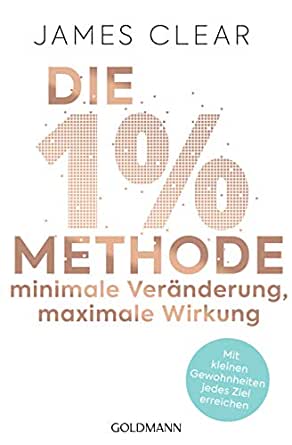
2. The 1% Method
The man who carried the mountain down was the same one who started carrying away small stones. – Confucius
In a world where most people want everything at once and right now, very few want to hear about "small stones" or steps. Our culture is shaped by slogans like "All or nothing" or – as Americans so beautifully put it – "Go big or go home!". The media is full of stories about huge changes and life decisions. In all this reporting, we often forget why that is: Small steps are simply not entertaining. Radical transformations, on the other hand, create tension and drama. And they do so for one main reason: They are the exception and not the rule!
James Clear focuses with his 1% Method on the idea of daily steps that are so small that you can take them right here and now to get 1% closer to your goal. These steps then become small habits that, in the long term, unleash enormous power. By the way, the same basic idea is behind all our 6-Minute-Journals.
So the idea of the 1% Method is not new. The packaging of this idea, on the other hand, is: Like no other author I know, Clear has managed to turn the current state of research into an extremely practical book. The book is so substantial that I have read it more than once. At the same time, it reads like an easy-to-understand user manual with which you can change your habits step by step.
This book is for you if:
- you want a user manual to build useful habits and get rid of bad ones
- you have great difficulty making small changes in your life stick in the long term
- you want to understand how your habits are linked to your identity, and how you can adapt your identity
P.S.: If you don't want to read a whole book on the 1% Method right away, this post gives you a first, crisp impression of why the idea behind it is so incredibly powerful.
____________________
3. Good Habits, Bad Habits
Motivation gets you started. Habit is what keeps you going. – Jim Rohn
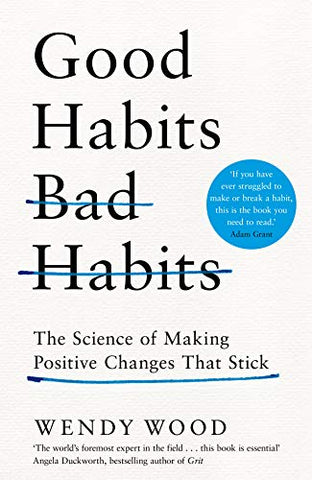
What the American author Jim Rohn said 100 years ago is supported by the English psychologist Wendy Wood with numerous studies: Goals and willpower are almost completely irrelevant for long-term changes. The author repeatedly emphasises that we overestimate the importance of willpower in our society (just compare the famous Nike slogan: "Just do it!") while habits secretly guide our lives.
How long does it take for a habit to become firmly rooted? From what point on do we even speak of a habit? Why is the environment the most important factor for building a habit? The answers we have to these questions today are based largely on the research that Wendy Wood has conducted over the last three decades.
Even though the book is peppered with everyday examples, the practical sections are kept rather short. The focus is on the numerous studies that show how habits work and influence our behaviour.
This book is for you if:
- you have very good English skills, because the book is not available in German
- you want everything that science knows about habits bundled together
- you want to understand why habits are much more important for your goals than your goals themselves
- you want to understand the functioning of habits in depth (from the perspective of a full-time researcher)
____________________
4. Hooked
Our lives would be a lot nicer if the brain were able to distinguish between good and bad habits. Unfortunately, the marketing industry does not always use this inability for good. Technology companies spend hundreds of millions to control our habits for their purposes – whether it is scrolling through the social media feed at the slightest hint of boredom or Googling at the slightest feeling of uncertainty. But how does it happen that 90% of all online buyers first read Amazon reviews before buying something online? Why does every third German search for love on the internet? And why are two out of seven people on this planet registered on Facebook?
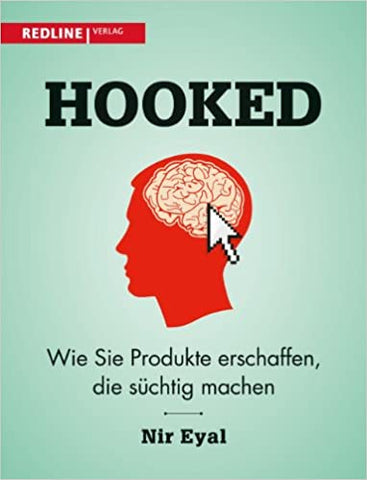
The author describes how these companies have simply managed to change our habits. And once a habit is firmly rooted, they have us hooked like the angler has the fish. That is why the title of the book is also "Hooked", which means "having been bitten". Nir Eyal addresses the moral aspect of "hooking customers" with surprising openness and not only calls on the reader to "practise good manipulation" themselves, but also gives tips to expose bad ones.
The author not only explains the psychology behind products that have us hooked, but also gives the reader very practical tips at the end of each chapter to deal with it better in everyday life. In this way, he builds very good bridges between theory and practice as well as psychology and product design.
This book is for you if:
- you want to understand how apps, online shops & Co. managed to sneak into our lives
- you want to create a digital product that makes your customers “addicted”
- you want to understand how susceptible you are to manipulation
____________________
5. The 6-Minute-Success Journal

Your next summer holiday is just around the corner, but your beach body is still in the depths of hibernation. So you sign up for an affordable annual membership at the gym around the corner, because you could hardly be more motivated. But instead of your love handles shrinking, it’s your motivation that dwindles – because before long, you slip back into your old ways. The reason: A big goal may give you a short-term motivation boost. But if you don’t build the right habits, you’re likely to fail because your motivation gets lost in the stress of everyday life.
But this can be changed: In the 6-Minute-Success Journal, I’ve distilled the key insights on the subject for myself – and by now, for many readers too. This book not only offers a concise overview of the theory behind good habits and how to build them, it also helps you actually take action – whether you want to get fitter, start an online business, or turn the universe upside down.
In just 6 minutes a day, you can easily and effectively build several good routines: You’ll learn to set the right priorities every day and focus on what really matters. You’ll also develop small habits that align with your values and bring you a little closer to your goal every day. This takes less effort, makes you feel good more often, and makes the journey much easier.
This book is for you if:
- you want to achieve maximum impact with minimal effort
- you’re looking for the perfect harmony of values, goals, and habits
- you want to bring more clarity, focus, and inner peace into your life
- you want a well-researched, field-tested daily planner to finally get you into action
____________________
6. The Compound Effect
Literally translated, the book’s original title is “The Compound Effect.” This title is much more apt, because the compound effect isn’t a formula, but a tireless workhorse that’s active day and night. The only question is whether this workhorse is currently working in your favour or against you. If you’d like to know more about why this effect is so powerful, you’ll find practical examples and anecdotes on the subject in this post.
Just to give one example: The more you see yourself as a negative or boring person, the more situations in your life you interpret through the lens of those beliefs. This mindset compounds against you until it becomes part of who you are and your identity. Compound interest is a double-edged sword: Over time, it becomes your worst enemy when it comes to bad habits, while with good habits, it gradually becomes a better friend. This book is all about ending up on the right side of the blade.
This book is for you if:
- you can read English or are willing to wait until October, when the German translation comes out
- you want to explore the basic idea behind the 1% method (small steps that lead to huge progress over time) in greater depth
- you want to understand why quick results are often unhealthy and short-lived
- you’re frustrated because your life isn’t changing as quickly as you’d like
____________________
7. Tools of Titans
Success is liking yourself, liking what you do, and liking how you do it. – Maya Angelou
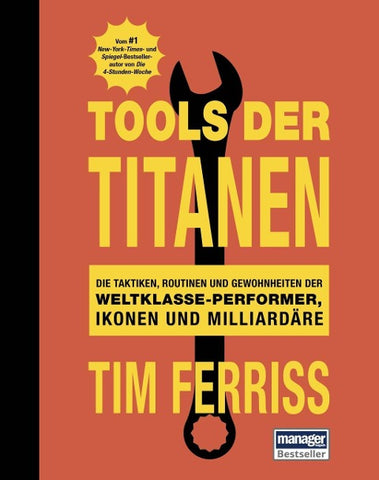
Whatever your personal definition of success, you’re sure to find inspiration here, because Tim Ferriss conducted more than 200 podcast interviews with top performers from around the world for this book. They include authors such as Paulo Coelho, Hollywood stars like Jamie Foxx, athletes like LeBron James, as well as doctors, artists, and entrepreneurs. The Tim Ferriss Show–the author’s podcast – has been downloaded more than half a billion times. Partly because of its enormous reach, many of his interviewees agreed to a two- to three-hour interview for the very first time. It’s no wonder Tim Ferriss has also been called “the Oprah of audio.”
Around 200 interviews are condensed into punchy summaries of four to six pages each and divided into the categories of health, wealth, and wisdom. So you can happily read only what’s relevant to you right now – and ignore the rest.
This book is for you if:
- you want to learn from the habits and experiences of successful role models
- you want practical (and often quite exotic) tips, not dry theory
- you want a book you can dip into from time to time, rather than having to dutifully read from cover to cover
____________________
8. The 7 Habits of Highly Effective People

A literal translation of the English original is “7 Habits of Highly Effective People.” However, this is not just a guide to desirable habits, but a handbook for living a good life. Although the first edition was published more than 30 years ago, it’s still one of the most comprehensive and, in my opinion, best works on “changing habits.” It’s no coincidence that the book has sold more than 20 million copies and been translated into 38 languages.
If “effectiveness” immediately makes you think of business, work, and the like, you’ll be pleasantly surprised, because Covey explores in detail how we can also improve our personal relationships. Drawing on interesting examples from his own life – with his children, his wife, and his many business relationships – Covey describes seven habits for a good life:
- Be proactive
- Begin with the end in mind
- Put first things first
- Think “win-win”
- Seek first to understand, then to be understood
- Synergize
- “Sharpen the saw”
P.S.: This book had a strong positive influence on my personal and professional life. For example, point 5 has been my daily journal affirmation for a good year now.
This book is for you if:
- you’re looking for a personal development book that distills the essentials so concisely that you can – and should – read it again and again
- you’ve heard of the famous “Seven Habits” and now want to incorporate them into your life
- you want to improve your professional performance
____________________
8. Mindset
The happiness of your life depends upon the quality of your thoughts.– Marcus Aurelius
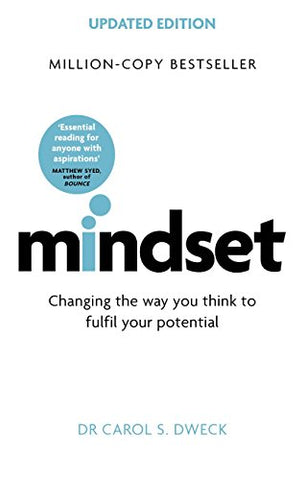
Everyone experiences ups and downs. Roman philosophers already knew that your fundamental mental attitude determines how you deal with them. What’s new in this book is the idea that there are exactly two such fundamental attitudes, or “mindsets” – the fixed and the growth mindset. The American psychologist Carol Dweck discovered through decades of research that these two mindsets are the main reason some people learn more, and therefore become more successful (at school, work, parenting, relationships, etc.) and more content than others. If you want to find out which mindset you have, answer the following questions briefly and honestly:
- Do you see mistakes as an opportunity to try something new and develop? Or do you sometimes experience mistakes as a threat or even as a judgment of your worth?
- Are you firmly convinced that you can develop your abilities? Or do you think whether you can do something depends more on your talent and intelligence?
- Do you learn new things to understand and discover more? Or do you primarily learn to receive positive feedback – for example, a good grade, a bonus, or praise?
If you answered yes to the first question in each pair, you tend towards a growth mindset. Otherwise, you have a fixed mindset. The good news is that our mindset isn’t set in stone; with proactive practice, it can be changed for good. In this book, you’ll learn how, with enough practice, the right mindset can become second nature. Personally, “Mindset” was a real eye-opener for me.
This book is for you if:
- you want to understand why both positive labels (e.g., “I can do anything!”) and negative labels (e.g., “I’m bad at math”) can be harmful
- you want to learn how to criticise or praise employees, children, friends, etc. in the right way. This book is a must for all teachers, coaches, trainers, and managers!
- you want to develop the habit of turning every problem into an opportunity: a growth mindset
- you’re looking for strategies to reach your full potential over the long term
____________________
10. The One Thing
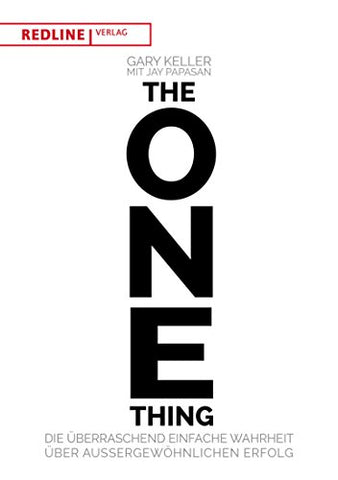
The principle behind Keller's book has probably contributed more to the success of our 6-Minute-Journals than anything else. But it works not only for authors, but also in all other professions and in your personal life. Gary Keller calls it “The One Thing” and explains that in the world of success, only a very small number of selected efforts are responsible for the vast majority of results and rewards. That's why big dreams and projects rarely need more time. They just need more focuson “the one thing”.He who hunts two hares at once will catch neither. – Confucius
In compelling anecdotes and stories, he makes a very persuasive case for why a crystal-clear focus on the (very!) few truly important things leads to a happier and more successful life. The great thing about this book is that the author has tested and refined his strategy in his own life for decades.
This book is for you if:
- you want to increase your productivity
- you often try to achieve too many goals at once
- you want to develop perhaps the most important habit of all: focus
____________________
And now?
Imagine you want to learn self-defence. You certainly wouldn't spend one week training in karate, then another week in taekwondo, then another in kung fu, judo, etc. Instead, you would choose one path and pursue it consistently until you mastered your chosen martial art, wouldn't you? The same goes for books on the topic of “changing habits”: Less is more!
To make the choice even easier after this whirlwind tour of the world of habits, I'll reveal my personal favourites. Both “The 1% Method” and “Mindset” and “The 7 Habits of Highly Effective People” have changed my life – and I bet they can do the same for you!
____________________
This post is by Dominik Spenst, founder of the 6-Minuten-Verlag, author of the 6-Minute-Diary and 6-Minute-Success Journal. When he's not writing 6-Minute-Journals, he's browsing non-fiction books or praising his employees so discreetly that they don't notice.
Sources:
[1],[2] 45% of our behaviour repeats daily / 70% of our thoughts repeat daily: Wood, Wendy/Qinn, Jeffrey M./ Kashy, Deborah A. (2002): Habits in Everyday Life: Thought, Emotion and Action, in: Journal of Personality and Social Psychology, Issue 83 (6)
[3] Only 5% of our decisions are conscious: Zaltmann, Gerald (2003): How Customers Think: Essential Insights into the Mind of the Market
[4] "Americans fear nothing more than cancer: MetLife Foundation Alzheimer's Survey", MetLife Foundation, February 2011, https://www.metlife.com/content/dam/microsites/about/corporate-profile/alzheimers-2011.pdf.
[5] The 5-a-day campaign changed Americans' knowledge: Gloria Stables et al., "5 A Day Program Evaluation Research," in 5 A Day for Better Health Program Monograph, eds. Gloria Stables and Jerianne Heimendinger (Rockville, MD: MasiMax, 2001), 89-111.
[6] The 5-a-day campaign had no effect on behaviour: Sarah Stark Casagrande et al., "Have Americans Increased Their Fruit and Vegetable Intakt? The Trends Between 1988 and 2002," American Journal of Preventive Medicine 32, no.4 (2007): 257-63, doi:10.1016/j.amepre.2006.12.002.
[7] Four times as many mentions of “goals” as “habits” from 1960 to 2010: Google Books Ngram Viewer
493 comments
Hi Dominik, ich habe deinen Beitrag gerade in einem durchgelesen, was mir bei Buchtipps, und dann noch so vielen, eigentlich nie passiert. Ich finde besonders spannnend, wie die Bücher auch dich beeinflussst haben, auch wenn mir klar ist, dass jedes Buch bei jedem Menschen anders ankommt. Irgendwie klangen alle nen Bücher sehr bereichernd, also fällt mir die Wahl umso schwerer: Ich würde mich freuen über:
- Die Macht der Gewohnheit, weil ich damit erstmal den Fokus auf das Verständnis legen würde
- Die 7 Wege zur Effektivität, um das Verständnis dann in mein Leben zu integrieren
Vielen Dank, herzliche Grüße und weiter so,
Ute
Von Euch weiterhin inspiriert zu werden, hat für mich absolut einen Mehrwert.
„Die sieben Wege …..“ und „Mindset…“ interessieren mich.
Ganz ❤️-lichen Dank für diese schöne Möglichkeit !!
Lieber Dominik & Team,
soeben habe ich mein zweites 6-Minuten-Tagebuch vervollständigt. Die “7-Wege” habe ich schon gelesen. Die Kampfdportarten hatte ich bereits alle angefangen. Daher freue ich mich sehr darüber, dass ich die 2) “1%-Methode” und die 8) MINDSET gewinne und lesen darf.
Weiter do! Ihr seid spitze!
Herzlichst und erfolgreich
grüßt Euch
Bärbel
Hi Dominik,
das ist ja ne coole Aktion.
Mindset und The One Thing wären top! Das letztere steht eh schon auf meiner Liste.
Vielen Dank 🙏
Grüße
Katja
In meiner aktuellen Situation sind die Bücher die “7 Wege zur Effektivität” und “Mindset” eine Bereicherung und ich freue mich über den Gewinn dieser beiden excellent beschriebenen Bücher.
Herzliche Grüße
Sigrun
Finde die 7 Wege und die 1% Methode am spannendsten :)
Hi,
ich nutze auch seit längerem das 6 MINUTEN Tagebuch und bin begeistert! Auch die hier dargebotene Buchliste finde ich top, da es in diesem Bereich einfach soviel verschiedene Bücher gibt.
Ich freue mich über folgende Bücher freuen:
1. Mindest (Nr. 8.)
2. The one thing (Nr. 9.)
Vielen Dank!
Hallo,
Vielen Dank für eure Newsletter und die Möglichkeit zum Gewinnen meiner Favoriten: „Die 1% Methode“ und
„Die 7 Wege zur Effektivität“.
Ich freue mich auf methodisch 1% mehr Effektivität 😁.
Viele Grüße
Danke für das neue Lesefutter.
Ich selber lese gerade die High Performance Habits und habe schon die 7 Wege gelesen.
Deswegen interessiert mich die 1%-Methode und die Good Habits.
Selam Dominik,
Affirmation: Ich gewinne „1% Methode“ und „Mindset“ …Ich gewinne „1% Methode“ und „Mindset“ …Ich gewinne .“1% Methode“ und ….
Bin jetzt ne Weile beschäftigt! Also erstmal LG …
Hallo,
Ich reihe mich ein in die Riege derer, die Bücher gewinnen möchten und meine zwei Favoriten sind:
Die 7 Wege zur Effektivität und Die 1% Methode .
Vielen Dank
Merle
Meine Favoriten sind :
Die 7 Wege zur Effektivität
Die 1% Methode
Danke dass du dein Wissen mit anderen teilst! :)
Ich favorisiere "7wege zur Effektivität " und " mindset"… da hab ich "Hunger " drauf unf möchte es in mein leben integrieren…
Hallo UrBestSelf,
ich bin seit mehr als 2 Monaten eine begeistete 6-Minuten Tagebuch Nutzerin und noch voll motiviert :). Jedoch ist das Thema Gewohnheiten in den verschiedensten Bereichen manchmal noch schwer zu überwinden, wie der weltbekannte “innere Schweinehund”….ich denke, dass die 1% Methode mich noch mehr dabei unterstützen könnte alte nicht so gute Gewohnheiten länger “schlafen zu legen” oder evtl. für immer. Mit tatsächlichen “fokussieren” und nicht zu viele Ziele auf einmal anzustreben, da könnte ich mich auch noch ein bisschen mit “The One Thing” einlesen.
Ich würde mich mega auf diesen beiden Bücher freuen – vielen Dank für die Möglichkeit.
Auch vielen Dank für diese tolle Idee mit dem 6-Minuten Tagebuch – es bereichert heute schon mein Leben und wäre hätte gedacht, dass mit 6 Minuten am Tag schon mindestens der halbe anstehende Tag positiver wird.
Herzliche Grüße <3
Sabine
Super Blog-Beitrag – wie immer :D
Ich würde mich total über die beiden Bücher “Hooked” & “Tools der Titanen” freuen.
Mega interessante Themen und bestimmt sehr hilfreich.
Danke euch ♥
Hallo Dominik,
danke für die Bücherhinweise. Ich favorisiere Mindset und die 1% Methode.
Viele Grüße
Fabian
Noch ein einziges Mal versuche ich es mit einem Gewinnspiel! ;-)
Mich sprechen “Die 1% Methode” und “Mindset” am meisten an.
So oder so, vielen Dank für die Buchtipps!
Hallo liebes Team,
herzlichen Dank für eure tollen Buchtipps. Ich werde mir das ein oder andere Buch ganz sicher zulegen. Vielleicht klappt es ja hier schon mit etwas Glück. Meine Favoriten sind:
- “Die 7 Wege zur Effektivität” von Stephen R.. Covey
- " Die Tools der Titanen" von Tim Ferris
Meine Favoriten sind:
Die 1% Methode
Die Gewinnerformel
Dank eures Tagebuch kann ich erste positive Erfolge in der Veränderung meines Denkes bemerken, noch mehr positiv verstärkende Lektüre nehme ich sehr gerne auf!
Hallo!
Danke für die tollen Buchtipps :)
Ich würde mich über “Die 1% Methode” und “The One Thing” freuen.
Liebe Grüße,
Melanie
Lieben Dank für die wöchentlichen Tipps. Das ist so inspirierend. Ich würde gern – “Die 7 Wege zur Effektivität” von Stephen R..
- “Mindset” von Carol Dweck haben. Herzliche Grüße Konni
Hallo,
mich würden folgende zwei Bücher interessieren:
2) Die 1 %-Methode
9) The One Thing
Liebe Grüße an ALLE :)
Lese mir immer wieder gerne deine Beiträge durch :-) Vorallem wenn man gerade in Arbeit versinkt lege ich sie für einen kurzen Moment beiseite und lese in Ruhe deine Achtsamen Drei.
Ich würde mich freuen wenn ich folgende Bücher gewinne:
“Die 7 Wege zur Effektivität”
“Hooked "
Weiter so!
Vielen Dank
Liebes urbestself-Team,
lese auch immer sehr gerne euren Newsletter!
Diesmal wieder mit einem großen Hoffnungsschimmer, endlich diese schlechten Angewohnheiten loszuwerden!
Ich würde mir für den Fall einer Auslosung „Die 1 %-Methode” und „Die 7 Wege zur Effektivität" wünschen.
Vielen Dank für eure nette Idee!
Viele Grüße
Andrea
Leave a comment
Discover the 6-Minute-Journals


👉 Everything you can be is already within you.

Dominik Spenst, Author & Founder of 6-Minuten-Verlag