
How gratitude changes your brain
Imagine living with someone who always reminds you of the beautiful things in your life. Someone who shows you in the morning that the crispy Froot Loops in your cereal look just like a rainbow and which birds you can hear chirping on your way to work. When you lie in bed in the evening, they remind you that the blanket is warm and protective over you and, quite incidentally, that negative emotions such as envy, anger, or fear seem to vanish in their presence. [1] [1] Please flex your gratitude muscle: www.spiegel.de/Psychologie/Dankbarkeit In fact, someone like that already lives inside you. Or rather, SHE already lives inside you. The name of this good lady? Gratitude!
Your brain as a house
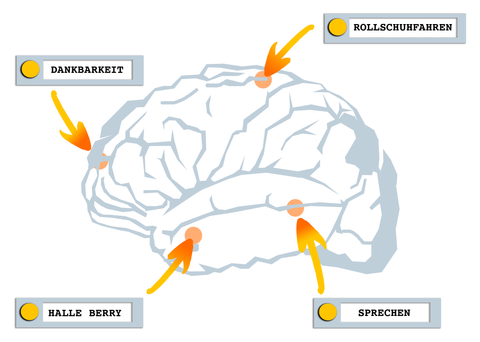
In our brain, millions of nerve cells bundle together into various regions that are responsible for the most diverse things: for speaking, roller skating, the thought of Halle Berry [2] [2] The Halle Berry cell: www.welt.de/Eine-Nervenzelle-erkennt-Halle-Berry or, in other words, gratitude. Very simply, you can imagine the brain as a house with many thousands of apartments in which little helpers live who are particularly knowledgeable in their respective areas of expertise.
An untrained brain is more harmful to health than an untrained body. George Bernard Shaw
What gratitude does
To see how the regular use of gratitude changes the brain, researchers from the University of Indiana asked their participants to practice gratitude for three weeks by expressing their gratitude to someone in a letter. [4] [4] Kini et al. (2016): The effects of gratitude expression on neural activty
They were allowed to decide for themselves who they wrote to and whether they really wanted to send the letter. It had already been observed in other studies that the guinea pigs felt significantly better afterwards. [5] [5] Jackowska et al. (2015): The impact of a brief gratitude intervention on subjective well-being, biology and sleep
But what's new is that this effect could also be proven in a brain scan: Writing the letters created a change in the structures of the medial prefrontal cortex – a region associated with gratitude and self-referential mental activities. [6] [6] Fox, Kaplan and Damasio (2015): Neural correlates of gratitude
The brain was, so to speak, remodelled by gratitude.
If you sometimes can't think of anything you could be grateful for, then we have a few ideas for you here.
Let gratitude move in with you
This clearly demonstrates: gratitude isn’t just a feeling that floats around somewhere. It sits in your head and becomes more and more anchored there the more grateful you are. Every time you consciously focus your attention on something you are grateful for, the neural connections in your brain are strengthened – much like turning up the heat in the room and making gratitude feel really cosy.
And then it's like well-practised mental math: You don't have to think long about what you are grateful for, it becomes more and more of an automatic process. Two times two is four and I'm grateful for ...!
Are you looking for your personal moving helper to let gratitude move in with you? Then take a look at our 6-Minute-Diary here :-)
____________________
This post is by Frauke Harlis. She loves writing just as much as psychology and has studied both. When she's not typing or entertaining her two offspring, she lies on the deck of her houseboat and looks for cloud shapes.
Sources:
[1] Please flex your gratitude muscle: www.spiegel.de/Psychologie/Dankbarkeit
[2] The Halle Berry cell: www.welt.de/Eine-Nervenzelle-erkennt-Halle-Berry
[3] Thinking helps: www.zeit.de/Hirnforschung
[4] Kini et al. (2016): The effects of gratitude expression on neural activty
[6] Fox, Kaplan and Damasio (2015): Neural correlates of gratitude
5 comments
Als ich das 6-Minuten-Tagebuch kaufte, wusste ich nicht, welchen Schatz ich da erstanden hatte. Ich legte das Buch ab, um es einmal weiterzuschenken. Dann nahm ich es einmal zur Hand und las darin! Sofort wusste ich, dass dieses Buch für mich wichtig ist. Mein Blick auf die Welt, auf mein Leben, auf meine Umgebung hat sich verändert. Ich danke jeden Morgen, dass ich nach einem guten Schlaf einen neuen Tag erleben darf. Ich schätze alles, was ich habe und erleben darf. Das, was ich nicht habe, ist nicht mehr vordringlich – das was ich habe, ist wertvoll geworden. Danke! Danke! Danke!
Schreibe normalerweise nie in die Kommentare, aber jetzt muss ich einfach Mal ein Danke für deine tollen Blog Einträge loslassen.
Habe schon viele Blogs durch, aber du hast echt Talent fürs Schreiben und Erklären :)
Merci, es hat geholfen und hoilft jeden Tag :)(
Dann fang ich direkt mal an und sage DANKE! Danke für den guten und interessanten Beitrag. Da ich seit Januar das 6 Minuten Tagebuch in mein Leben integriert habe, ist die Dankbarkeit sowieso schon ein Teil von mir. Aber der Artikel bringt mich nochmal positiv zum nachdenken.
Danke für den aufschlussreichen Beitrag!
Ich werde versuchen meiner kleinen Dame zu Hause es so angenehm wie möglich zu machen 😊
Leave a comment
Discover the 6-Minute-Journals


👉 Everything you can be is already within you.

Dominik Spenst, Author & Founder of 6-Minuten-Verlag