
The 6-Minute-Principle® – Reach Your Goals With Micro Habits!
Anyone searching Amazon for books on lifestyle or personal development will find more than 150,000 different titles. Self-help literature has not only grown significantly in recent years, it has also become considerably more specialised: nowadays there is a suitable specialist guide for almost every desire or problem. One could therefore expect that people are much more likely to achieve their goals today than 20 or 30 years ago. In fact, however, the exact opposite is true: The gap between what people want to do and what they actually do is widening – at least the alarming increase in people with sleep problems [1] [1] 80 percent of employees sleep poorly: DAK Health Report (2017): Sleep Disorders Are Rising Significantly in Sleepy Germany
, lack of exercise [2] [2] WHO Study: Wirtschaftswoche (2018): Germans Do Not Exercise Enough
and excessive stress [3] [3] Study: One in Two People Believes They Are at Risk of Burnout: Presseportal/pronova BKK (2018): 87 Percent of Germans Are Stressed
in Germany point to this.
How about you? What do you want to change in your life right now? Eat healthier, exercise more, sleep better, become more productive or more relaxed? How big is the gap for you between Wanting and Doing?
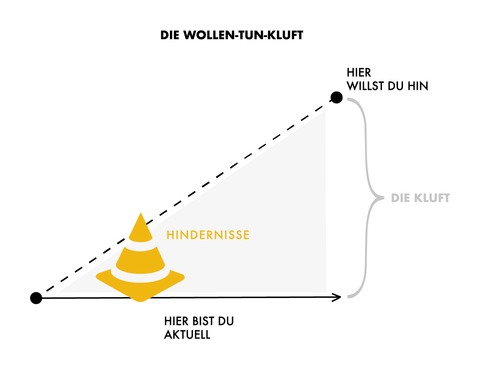
And why is that? If we believe traditional self-help literature, then either a lack of motivation or a lack of perseverance is to blame. And you yourself probably know thoughts like: “I just need to pull myself together more!” or “If I really wanted it, I would have done it.” The problem, however, is extremely rarely in your lack of abilities or qualities, but rather in the way you approach your goal. When we fail to achieve something despite our best intentions, we are often so busy looking for the flaw in our character that we never even think to question the approach itself – the system for implementation. We are good at criticising ourselves – but untrained in rethinking our approaches.
There is no single golden formula, we all know that. However, there is a toolbox in which you will find what around 2,000,000 people worldwide do with our 6-Minute-Principle® : small steps, small decisions, and small changes – with unexpectedly great results. Whether it is called the 1% Method [4] [4] The 1% Method: James Clear (2019): Atomic Habits , the 6-Minute-Principle®, Micro Habits [5] [5] Micro Habits: Matthias Hammer (2019): Micro Habits: How to Stop Bad Habits and Establish Good Ones or Mini Habits [6] [6] Mini Habits: Steven Guise (2013): Much Better Than Good Resolutions calls it. In the end, it always means the same concept:
Steps so small that you can take them right now to get 1% closer to your goal. These daily steps then become small habits that develop enormous power in the long term – and enrich your life in ways you never imagined.
The following eight reasons explain why this approach is probably the most fun and effective way to achieve big goals and long-term changes.
1) 1% Changes Your Whole Day
For a long time, my wife and I tried to establish a joint exercise routine. The problem was that I am a master of “just doing one more thing quickly” and my wife has a black belt in “let’s just go tomorrow instead.” That's why it was always quite complicated to find common ground twice a week. Now it has worked very well for two years. The solution was: lime water.
Every time we go to the gym together, I fill two bottles with freshly squeezed lime juice beforehand. Once the lime water is ready, the first domino has fallen. Even though the lime water was never really meant to play such a crucial role, we never think about postponing the workout after that. The rest of the dominoes fall automatically: We check for the next bus, pack our gym bag, drive to the gym, do our exercises, and cook together afterwards.
Mini habits like squeezing the lime water – that is, small actions that become almost automatic – are often laughed at because they have no major effect on their own. Yet we rarely think about how they also determine the actions that follow in the minutes and hours afterward. We often only see the small, individual domino, but are blind to the large chain reaction that is set in motion as soon as the first stone is nudged.
Every day has many key moments that determine whether the dominoes fall in a good or bad direction for you: The moment I take the lime out of the refrigerator and decide to work out instead of doing anything else. The moment you decide to order food or cook for yourself. The moment you decide to watch a series or work on your project. The moment you decide whether to drive or cycle to work.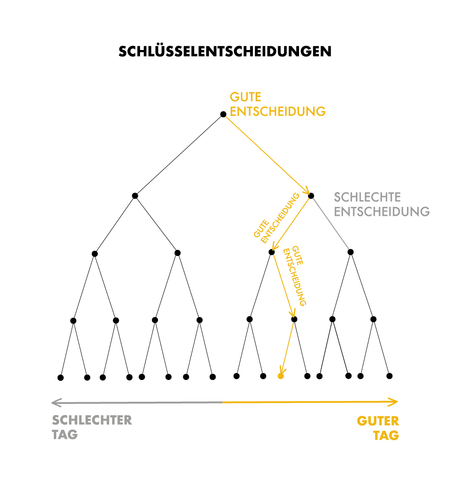
Once such key decisions have become established mini habits, they unleash their full magic. Because now the decisions that once required effort and energy run almost automatically. The once conscious key decisions become automatic decisions that positively influence all subsequent conscious decisions.
2) 1% Is Fast
Cook healthy every day? I am on board, but let’s start with that when there is less going on at work. Walk 10,000 steps every day? Sounds great, please write that in the calendar for Sunday. Write in my gratitude journal? Yes, I’d love to, as soon as the kitchen and the kids’ poop clean themselves…We often know very well which habits make us happier, more relaxed, and healthier. If only we had more time!
The more items on your stress agenda and the more fiercely your appointment tsunami rages, the more such habits will always have to take a backseat to your obligations. You can be as determined as you like about walking 10,000 steps every day, it will never become an established habit if you have the chronic feeling that you do not have enough time. Instead, you can simply start so small that it doesn’t even affect your time. Whether you walk around the block once or stroll through the flat while your coffee brews – the main thing is to keep the action so small that the factor of time itself no longer plays a role for even the most creative excuse-makers.
The man who carried the mountain away was the same one who started by carrying away small stones. – Confucius
In the same way, thousands of people have managed to finally establish a positive journaling-routine with the 6-Minute-Diary. Dividing the total time of 6 minutes into three in the morning and three in the evening lowers the threshold and thus enables – without any struggle or strain – the establishment of a daily routine. This makes the 6-Minute-Principle® a perfect module that is easy to maintain and finds a place even in the busiest of lives. If you are stressed and have too little time, building mini habits is not only the best option for long-term changes, it is probably also the only one.
3) 1% Is Easy
Just like 50,000 years ago with our ancestors, your grey cells are still constantly trying to save energy today. So if you would rather hang on your smartphone than work on your important project, or rather watch YouTube than have a workout session, the evolutionary lazy person in you is to blame. The path of least resistance, and thus also the tendency toward laziness and procrastination, is a firm part of human DNA. [7] [7] Study: Humans save energy wherever possible: Jessica C. Selinger, Shawn M. O'Connor, Jeremy D. Wong, J. Maxwell Donelan/Current Biology (2015): Humans Can Continuously Optimize Energetic Costs during Walking But if we are lazy by nature, why do people manage difficult things like running a marathon, starting a company, or raising a child?
Success is no small thing, but it starts with small things. – Socrates
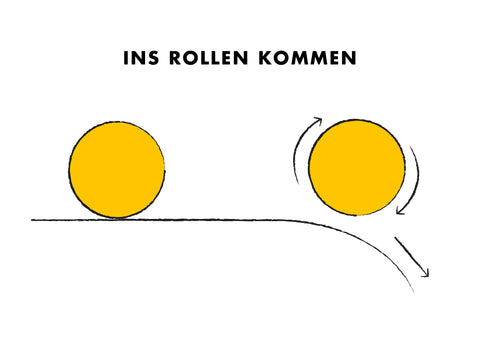
Not because they are consistently disciplined, but because they have managed to keep the hurdles to their big goals small at the crucial moments. And these moments are usually exactly those in which you start something. Because for every undertaking, the transition from standstill to movement – from inertia to activity – consumes the most energy. This applies just as much to starting an aeroplane as to getting on a bicycle, putting on your running shoes, or getting up from your couch. [8] [8] Energy consumption when switching from standstill to movement: Steven Guise (2013): Much Better Than Good Resolutions
If the start takes the most strength, it is advisable to get rid of as much weight as possible to make it as easy as possible. For this exact reason it is called the 6-Minute-Principle or the 1% Method and not the 30-Minute Principle or the 90% Method. As soon as you have managed the first, however small, starting movement, it is relatively easy to stay in motion. Once the first sock is folded, it is also easier to do the rest of the laundry. Once the first word has escaped your mouth, it is also easier to tell the rest. Then your drive – or as the Americans call it, momentum – is on your side, and the desire for more comes all by itself. (If you are looking for concrete tips on how you can develop good habits more easily, then read this post.)
4) 1% Is Not Dependent on Motivation
Motivation is difficult to control. Because it comes and goes, psychologists also speak of “motivation waves.” For example, according to statistics, about 100 million wave riders register for a paid online course every year. These people all started highly motivated and firmly believe that they will also complete the course. After all, they have already paid for it. Nevertheless, only 10% manage to actually complete the course. [9] [9] Motivation is not enough for long: BJ Fogg (2019): Tiny Habits: The Small Changes that Change Everything Whether it is about online courses, your promotion, or any other goal, the fact is that we humans have a tendency to overestimate our future motivation. [10] [10] Humans tend to overestimate future motivation: Loran F. Nordgren, Frenk van Harreveld, Joop van der Pligt (2009) The Restraint Bias: How the Illusion of Self-Restraint Promotes Impulsive Behavior When we ride a motivation wave, we are so enthusiastic that we forget how quickly it will break again.
But why does our motivation fluctuate like a flag in the wind? Because our emotions do the same: motivation depends on your emotions, which in turn are based on many different factors such as your blood sugar level, your hormones, your health, the weather, the mood of your colleagues, or fresh dog poop in front of your front door.
For this reason, big steps that require a lot of motivation are no solid foundation for long-term change. Giant steps are like trying to build a house on water. Small steps, on the other hand, are less dependent on your emotions and become an established habit more quickly, from which you can benefit easily and effortlessly in the long term. With motivation, you sign up for the online course or go to the first lecture of the semester. With the 1% Method, however, you do something every day for the online course or your lecture – thereby not losing touch and following through with your plans. Motivation is a short-term strategy, while the 1% Method is a long-term strategy.
5) 1 % even creates motivation
How often have you thought, “Oh, I’m just not motivated enough right now”? The idea that we need a certain level of motivation to get started is deeply rooted in our society. We typically think that motivation works something like this:
Motivation → desired action
However, studies have shown that motivation often arises only after we have got started – not before. [11] [11] The first step creates motivation: B.V. Zeigarnik/Psychological Research, Issue 9 (1927): On the Retention of Completed and Uncompleted Actions
Surprisingly, it doesn’t matter how large or small the action was. The feeling of success creates momentum, and this, in turn, creates motivation. Therefore, motivation is often the result of our actions, not their trigger:
Desired (even tiny) action → motivation
Once we have internalised this, we can use the 1% method to create motivation for ourselves again and again. Do you want to draw something? Then draw a line. Do you want to write an application? Then write a sentence. The motivation to do more will automatically follow. Before you know it, you will have completed the first drawing or written the first draft of your application. This type of active motivation is often even stronger and longer-lasting than the motivation that arises when we passively read an inspiring book or consume an uplifting video. [12] [12] Active inspiration is often more effective than passive: James Clear The Two Types of Inspiration So don’t rely on the next wave of motivation, but take the smallest, easiest step right here, right now – and create your own wave of motivation.
6) 1 % builds your self-confidence
In her youth, my Aunt Tanja was quite the athlete. But when she went through the breakup with her first great love, she turned into a couch potato. During this time, she gained 20 kilos and developed acute neck pain that made it difficult for her to work as an IT expert. The doctors prescribed more exercise, and so she began an “all-or-nothing cycle”: Tanja would repeatedly start extreme exercise programmes or radical diets, only to end up back on the couch with a bag of chips and/or gummy bears days, sometimes weeks later. But the enjoyment was quickly ruined by the bitter aftertaste of failure that lingered on her tongue whenever she thought of her goal. That aftertaste didn’t stop with her tongue; it also gnawed at her self-esteem.
This “all-or-nothing cycle” repeated itself for about 20 years. One day, a colleague told her that he did a single yoga pose every morning after getting up, which sounded anything but impressive to Tanja. The key, however, was that the same colleague had been practising 30 minutes of yoga every day for a few months. Tanja took notice and let go of her “all-or-nothing” maxim for the first time. From then on, she did ten push-ups after getting up, and no matter whether it was 10 or, on good days, 15 or 20 – because the requirements were so low, she achieved one success after another and remained motivated in the long term. Day by day, her gnawed-at self-esteem recovered, and for the first time, she fell in love with the process instead of just obsessively focusing on the end result. Eventually, she didn’t even have to force herself to do the push-ups anymore, because they had become a mini-habit. Instead of forcing herself, she simply let her habit autopilot run.
Small deeds that you do are better than big ones that you plan. – George C. Marshall
From the seeds she had planted back then, a sturdy tree had grown. Tanja now does a 20-minute workout every morning. At age 45, she weighs about as much as she did in her youth, and her neck pain is as much a thing of the past as her heartbreak. Of course, the story was a bit more complex in reality. The crucial point, however, is that daily 1% steps had strengthened Tanja’s self-confidence, and she now knows that she can change anything in life as long as she consciously experiences and celebrates the small successes along the way.
7) 1 % minimises the risk of failure
If you have never meditated before, you can start at different “risk levels.” Either you keep the risk low, sit on the floor in your living room, close your eyes, and pay attention to your breath for one minute. Or you book a meditation retreat in the Himalayas, risk wasting 3,000 euros, and tell all your friends how you realised after half an hour that meditation was nothing for you. Hardly anyone would do the latter. Why? Because something in our brain senses that the risk is too great. Just as something in your brain whispers to you that you shouldn’t go full throttle when you are standing on inline skates or ice skates for the first time in your life.
It is better to reach the goal in many small steps than to break your legs with one big jump. – Anonymous
Your brain naturally strives for safety. Instead of constantly fighting this urge for safety with big, daring actions, you can act according to your brain’s rules. That is exactly what you do with small steps that do not demand too much from you. You reduce the pressure on yourself and minimise the risk of failure. This way, you achieve small successes every day, which repeatedly trigger the release of the feel-good hormone dopamine.
By the way, for your sense of happiness, it is not the size of the progress that matters, but rather the frequency and the conscious experience of even the smallest progress. [13] [13] How professionals experience progress: Theresa M. Amabile (2017): The Progress Principle Study By writing down the small successes every day, your brain gradually develops an increased awareness of these even smallest progress points. [14] [14] Writing down successes changes your brain in the long term: Rebecca Beris (2016): Science Explains How Writing Down Tiny Achievements Every Day Changes Our Brains As a result, you are more motivated, and your brain is unconsciously convinced that greater successes are within reach. [15] [15] Small wins drive transformative changes: Karl E. Weick (1984) Small Wins: Redefining the Scale of Social Problems. American Psychologist 39: 40-49 You celebrate one success after another, and the desire for more follows automatically. And even if you stumble along the way, it means nothing – as long as you get back up – but is simply a habit in the building phase.
8) 1 % sprouts into all areas of life
This post is all about positive mini-habits with a major impact. Studies show that such habits are a breeding ground on which further positive routines can grow. [16] [16] As good key habits automatically give rise to others in the long term: Charles Duhigg (2013): The Power of Habits: Why we do what we do
The breeding ground for some routines is far more fertile than for others. For this reason, some routines – so-called “key habits” [17] [17] The importance of key habits: Charles Duhigg (2014): The Power of Habits: Why we do what we do in Life and Business
– are a much better investment of your energy and willpower than others. Undeniable examples of this are exercise, meditation, journaling or reading. Once established in life, these habits develop a tremendous momentum of their own. They spread to other areas of life and thus make it easier to build further desirable behaviours. Numerous studies impressively demonstrate how even very small key habits, often unconsciously, spread into areas that have no direct connection to the original habit.
One of these studies showed that making your bed regularly in the morning leads to higher productivity, better nutrition, and more responsible money management. [18] [18] How little things can improve our lives: Charles Duhigg (2013): The Power of Habits: Why we do what we do In another study, participants were asked to keep a household budget in which they recorded all their expenses for four months. Here too, not only did their finances improve, but the mini-habit also had an effect on other areas of life: The participants exercised more, drank less alcohol and caffeine, smoked less, ate healthier, and were more productive at work. [19] [19] Study on money management: Meagan Oaten, K. Cheng (2007) Improvements in Self-Control from Financial Monitoring In a similar way, our 6-Minute-Journals are also designed as key habits that, over time, effortlessly lead to other good habits – such as gratitude, mindfulness, or optimism.
When was the last time you built a positive routine? Didn’t other good habits automatically follow? And now for the crucial question: Why do you want to build huge new habits when just a few already have enough power to carry you to your goals?
The essence
For the moment, a mini-habit is insignificant. However, over the sum of the moments that make up your days and ultimately your life, it can make the difference between the person you are and the person you want to be.
The seed is bigger than the tree. Because it contains the power for something even greater. – Peter Amendt
And now what?
What habit could you plant the seed for today? If you don’t have a suitable habit in mind, you’ll find inspiration here If you already know that you definitely want to build a stable journaling routine, then you’ll surely find something suitable here.
This post is by Dominik Spenst, founder of the 6-Minuten-Verlag, author of the 6-Minute-Diary and 6-Minute-Success Journal. When he’s not writing 6-Minute-Journals, he browses non-fiction books or praises his employees so discreetly that they don’t notice it.
Sources:
[1] 80 percent of workers sleep poorly: DAK Health Report (2017): Tired Germany: Sleep Disorders Are Rising Significantly
[2] WHO Study: Wirtschaftswoche (2018) Germans Do Not Exercise Enough
[3] Study: Half of All People Believe They Are at Risk of Burnout: Presseportal/pronova BKK (2018): 87 Percent of Germans Are Stressed
[4] The 1% Method: James Clear (2019): Atomic Habits
[5] Micro Habits: Matthias Hammer (2019): Micro Habits: How to Stop Bad Habits and Establish Good Ones
[6] Mini-Habits: Steven Guise (2013): Much Better Than Good Resolutions
[7] Study: People Save Energy Wherever Possible: Jessica C. Selinger, Shawn M. O'Connor, Jeremy D. Wong, J. Maxwell Donelan/Current Biology (2015): Humans Can Continuously Optimize Energetic Costs during Walking
[8] Energy Consumption When Switching from Stillness to Movement: Steven Guise (2013): Much Better Than Good Resolutions
[9] Motivation is not enough in the long run: BJ Fogg (2019): Tiny Habits: The Small Changes that Change Everything
[10] People tend to overestimate future motivation: Loran F. Nordgren, Frenk van Harreveld, Joop van der Pligt (2009) The Restraint Bias: How the Illusion of Self-Restraint Promotes Impulsive Behavior
[11] The first step creates motivation: B.V. Zeigarnik/Psychological Research, Issue 9 (1927): On the Retention of Completed and Uncompleted Actions
[12] Active inspiration is often more effective than passive: James Clear The Two Types of Inspiration
[13] How professionals experience progress: Theresa M. Amabile (2017): The Progress Principle Study
[14] Writing down achievements changes your brain in the long run: Rebecca Beris (2016): Science Explains How Writing Down Tiny Achievements Every Day Changes Our Brains
[15] Small wins drive transformative change: Karl E. Weick (1984) Small Wins: Redefining the Scale of Social Problems. American Psychologist 39: 40-49
[16, 18] As good key habits automatically give rise to more in the long run: Charles Duhigg (2013): The Power of Habits: Why we do what we do
[17] The importance of key habits: Charles Duhigg (2014): The Power of Habits: Why we do what we do in Life and Business
[19] Study on money management: Meagan Oaten, K. Cheng (2007) Improvements in Self-Control from Financial Monitoring
12 comments
Genialer Artikel Dominik! Nutze gerade mein fünftes, ja fünftes 6-Minuten Erfolgsjournal, gibt es irgendeinen Bonus, wenn man 6 Bücher von euren 6-Minuten Büchern nutzt ;-) ?
Dieser Artikel ist super, um zu verstehen, was hinter dem ganzen Ansatz steckt und hat mich noch mal zusätzlich motiviert, danke für deine Arbeit und auch für den Podcast, den ich jede Woche höre!
Grüße aus dem Süden Deutschlands,
Tobi
Lieber Dominik,
vielen Dank für diesen wunderbaren, so unkompliziert einleuchtenden und überzeugenden Artikel.
Ich bin in meinem dritten 6 Minuten Tagebuch und auch, wenn ich noch deutlich länger als 1/2 Jahr in/an einem Buch schreibe, merke ich, wie gut es mir tut.
Neben vielen anderen Sätzen, die mich sehr inspiriert haben, knabbere ich immer wieder an dem Satz bzw. an dem Phänomen, das du in Punkt 7 ansprichst: „Und selbst wenn du auf deinem Wage mal stolperst, bedeutet das – solange du wieder aufstehst – kein Scheitern, sondern ist einfach nur eine Gewohnheit in der Aufbauphase.“ Ich hatte es mir zu Gewohnheit gemacht, von meinen acht Qi-Gong-Übungen eine morgens zu machen. Das habe ich wohl ein halbes Jahr gemacht und glaubte, diese Zeit reicht aus, damit diese Gewohnheit etabliert ist. Ich weiß nicht, was geschehen ist, aber die Gewohnheit ist futsch und ich komme nicht mehr rein. Ich werde dein Beispiel mit der einen Yoga-Position ausprobieren, um was Neues anstelle des Alten (für mich irgendwie Gescheiterten) zu setzen. Kann es wirklich sein, dass man/ frau länger als 6 Monate braucht, um einen neue Gewohnheit wirklich in sein Leben zu holen??
In Anlehnung an die Punkte 5 und 6 deines Artikels und Aussagen aus obigen Kommentaren werde ich dein Erfolgstagebuch bestellen und ausprobieren.
Vielen Dank für deine Arbeit und deine Begleitung in Form des 6 Minuten Tagebuchs.
Liebe Grüße
Anne
Ich habe das 6-Minuten-Erfolgsjournal geschenkt bekommen und meine erster Gedanke war: mach ich doch schon, brauch ich nicht. Hintergrund war, dass ich in meinen Handy Kalender schon lange eintrage, was ich am Tag machen werde. Der große Unterschied allerdings ist, dass man im Handy Kalender ganz schnell Sachen löschen oder verschieben kann und am Ende dann doch nichts Produktives passiert ist.
Seit ich das Buch habe, funktioniert das nicht mehr. Denn nun habe ich es schwarz auf weiß da stehen, was ich am Tag machen werde/ will, worauf ich meinen Fokus lege, usw. und ich will – das ist meine Motivation – diese Häkchen setzen am Ende des Tages. Die sind meine Belohnung, dass ich es geschafft habe, und zwar alles, was ich mir vorgenommen habe.
Das Buch hat mich und mein tägliches Tun so unglaublich verändert, dass ich erstaunt von mir selbst bin. Und von dem, was das Journal sozusagen versprochen und dann eben auch gehalten hat.
Vielen vielen Dank dafür. Ich habe tatsächlich mein ganzes Leben damit verändert, und zwar nur zum Positiven! Ich habe schon mehrmals oben links in die Ecke, wo steht: “Ich bin dankbar für” geschrieben: “Für dieses Journal!”
Hey Dominik,
Ich habe sowohl das 6-Minuten-Tagebuch als auch das 6-Minuten-Erfolgs-Journal in Nutzung und kann dir sagen, dass dieser Blog-Text mich noch mehr von deren Sinnhaftigkeit und Konzept überzeug hat. Was haben diese Texte also hier online zu suchen? Ab in eure 6-Minuten-Bücher damit, Dominik!
Gute Grüße aus dem südlichsten Süden in den Norden,
Luca
Es ist fast nicht zu glauben – aber die kurze Zeit, die es am Morgen braucht, um das Erfolgsjournal auszufüllen, entscheidet über den Erfolg des ganzen Tages! Immer wieder merke ich, wie sich ein Tag “einfach besser” anfühlt, wenn ich mir am Morgen Zeit nehme für die kurze schriftliche Fokussierung, als wenn ich mir nur Gedanken mache und nichts aufschreiben. (Beweis für Grund 1) :-)
Ein grosses und herzliches Dankeschön für die wöchentlichen Achtsamkeitsberichte und den Erfinder/innen und Entwickler/innen den Erfolgsjournals.
Liebe Grüsse Claudia
Vielen Dank für diesen an interessanten Erkenntnissen und Beobachtungen geradezu überquellenden Beitrag. Ich habe ihn jetzt schon mindestens vier Mal guten Freunden weiter empfohlen. Der Antwort auf die Frage, warum wir so oft scheitern, wenn wir uns etwas vornehmen, fühle ich mich nun ein Stück näher gekommen: Es liegt nicht daran, dass wir nicht stark genug sind sondern daran, dass wir die Hürden zu hoch ansetzen. Dieser Gedanke motiviert mich jetzt jeden Tag wenigstens mit einer Kleinigkeit das Richtige zu tun.
Ich freue mich auf weitere spannende Artikel von euch.
Hallo Dominik
über Leo Baubauta bin ich das erste Mal auf das Konzept von Mini-Gewohnheiten gestoßen und James Clear schreibt ja in seinem Blog auch oft darüber. Sie nennen sie zwar nicht so, aber meinen dasselbe. Auch wenn ich die Idee also schon länger kenne, hab ich das Warum dahinter noch nie so schön zusammengefasst gesehen. Grund 5 und 8 waren mir auch inhaltlich komplett neu. Danke wieder mal für die wertvollen Infos.
Mich würde bei Grund 8 noch interessieren, warum manche Gewohnheiten so „fruchtbar” sind und sich so ausbreiten. Ich glaube das total und kenne es auch selbst von mir, aber warum ist das so? Was hat Haushaltsbuch führen mit den ganzen anderen Bereichen zu tun? Vielleicht ein Thema für einen nächsten Blog oder gerne kannst du mir dazu auch Infos per Mail schicken.
Lieben Gruß,
Maria
Hey Dominik,
deine Gewohnheit ist auf jeden Fall, sich mit Gewohnheiten zu beschäftigen ;-)
Spaß beiseite: Ich würde einen Beitrag spannend finden, in dem du mal über all deine Gewohnheiten schreibst und wie genau du sie erlangt hast, so ähnlich wie du auch vom Limettenwasser berichtet hast. Mit welchen Gewohnheiten schreibst du deine Bücher, welche Gewohnheiten treiben dich durch den Arbeitsalltag und wie hast du sie aufgebaut?
Unabhängig davon, was du mit meinem Vorschlag anfangen wirst: Vielen lieben Dank für diesen klasse Artikel.
Beste Grüße, Richard
Ich bin gerade bei meinem fünften 6-Minuten Tagebuch, was für eine Bereicherung dieses Buch! Dafür ein herzliches Danke an Dominik und Team!!
Frage: Warum ist diese Erklärung eigentlich nicht Teil der Bücher? Wäre sinnvoll denke ich. Ich finde, vor allem den den ersten und den fünften Punkt besonders wichtig. Den Beitrag habe ich meinem Bruder weitergeleitet, weil er Probleme hat, endlich seinen xxx zu bewegen. Aber auch für mich war er sehr motivierend, endlich wieder ein Projekt anzupacken, das schon viel zu lange auf mich wartet!
Hi Dominik,
danke, ein sehr überzeugender Beitrag! Ich habe mir direkt euer neues Erfolgs-Journal bestellt, bin echt gespannt, ob das Prinzip auch solche Früchte bei mir tragen wird wie beim Tagebuch. Weiterhin alles Gute, Nils.
Mist, ich bin deine Tante. “Alles oder nichts”, “Ganz oder gar nicht” – so anstrengend und einfach nicht erfolgreich und seit Jahren versuche ich schon abzunehmen! Das hier war gerade ein Augenöffner: Es muss nicht alles auf einmal… im Gegenteil sind es kleine Schritte, mehr Geduld und Konstanz. Eine neue Gewohnheit, wie du so schön sagst und sie kann echt mini sein – sehr erleichternd. Ich bin zuversichtlich, dass es klappt, denn meine mini Erfolge will ich auf dem Weg zelebrieren. 1% ist besser als kein Prozent, richtig? Richtig.
Vielen Dank für diesen wertvollen Beitrag, Dominik :)
Wow, herzlichen Dank für dieses kleine Essay und die Gedankenanstöße darin!
Für mich auch spannend, um die Philosophie hinter meinem 6-Minuten-Tagebuch zu verstehen. Die war mir irgendwo schon klar, ist jetzt aber doch deutlich klarer :)
Nachdem ich den Beitrag heute morgen in Ruhe durchgelesen habe, muss ich sagen, dass tatsächlich sehr viel auf mich zutrifft…. Ich konnte echt zu jedem Punkt etwas für mich herausschreiben….. Die Geschichte von deiner Tante hat mich auch inspiriert und mein Favorit ist Grund 1.
In diesem Sinne auch nochmals danke für eure achtsamen Drei jede Woche!
Leave a comment
Discover the 6-Minute-Journals


👉 Everything you can be is already within you.

Dominik Spenst, Author & Founder of 6-Minuten-Verlag